
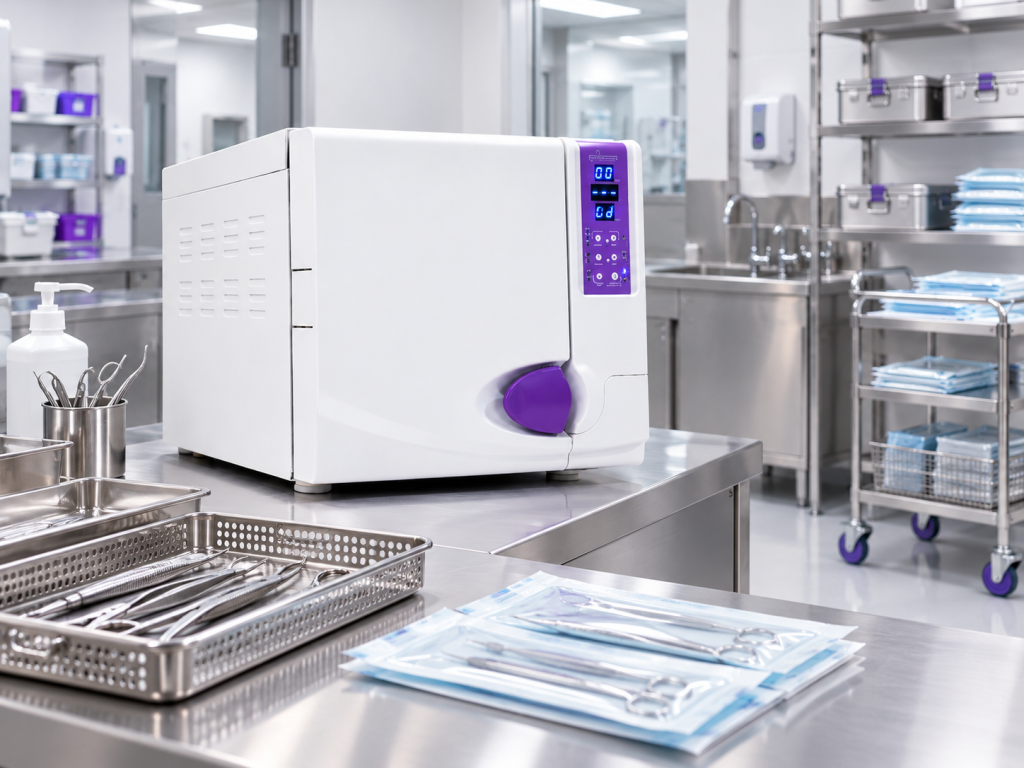
Hospital Autoclaves: A Guide to Steam Sterilisation in Healthcare
Hospital Autoclaves: A Guide to Steam Sterilisation in Healthcare
Hospital autoclaves play a critical role in the decontamination and sterilisation of reusable medical instruments. In acute healthcare settings, reliable steam sterilisation helps ensure that surgical instruments and other reusable medical devices are processed safely before they are returned to clinical use.
For hospitals and larger healthcare environments, choosing the right autoclave means looking beyond chamber size alone. Capacity, cycle performance, validation, servicing, testing, traceability and workflow all need to be considered.
This guide explains how hospital autoclaves work, where they fit within the decontamination process and what healthcare teams should consider when selecting and maintaining sterilisation equipment.
What Is a Hospital Autoclave?
A hospital autoclave is a steam steriliser designed to process reusable medical instruments using high-temperature saturated steam under pressure.
The purpose of the autoclave is to destroy microorganisms, including bacteria, viruses, fungi and bacterial spores, so that reusable instruments can be safely returned to clinical use.
In hospital environments, autoclaves are commonly used as part of a wider decontamination system that may include:
- Instrument collection
- Cleaning and disinfection
- Inspection
- Packaging
- Steam sterilisation
- Drying
- Storage
- Traceability and record keeping
NHS England’s HTM 01-01 guidance covers the management and decontamination of reusable surgical instruments used in acute care, including steam sterilisation in sterile services departments.
Why Steam Sterilisation Is Widely Used in Hospitals
High-temperature steam remains one of the preferred sterilisation methods for reusable medical devices that can tolerate heat and moisture.
Steam sterilisation is widely used because it can provide:
- Reliable microbial destruction
- Effective penetration of suitable loads
- Repeatable cycle performance
- Documented processing conditions
- Efficient instrument turnaround
NHS guidance states that high-temperature steam should be used as the preferred sterilant where appropriate, with alternative methods reserved for loads that could be damaged by steam or cannot be effectively sterilised using it.
Hospital Autoclaves and Sterile Services Departments
In larger hospitals, reusable instruments are often processed through a dedicated sterile services department, sometimes referred to as an SSD or CSSD.
These departments are responsible for managing the complete decontamination pathway, from receiving used instruments through to sterilisation and return to clinical departments.
A hospital autoclave therefore forms part of a wider system rather than working in isolation.
A typical sterile services workflow may include:
- Receiving contaminated instruments
- Cleaning and disinfection
- Inspection and preparation
- Packaging
- Sterilisation
- Drying and cooling
- Storage and distribution
- Cycle documentation and traceability
The efficiency of the entire department depends on each stage working correctly.
What Should Hospitals Consider When Choosing an Autoclave?
The right hospital autoclave depends on the clinical environment and the volume and type of instruments being processed.
Key considerations include:
- Daily instrument volume
- Chamber capacity
- Instrument size
- Wrapped and hollow loads
- Cycle speed
- Steam penetration
- Drying performance
- Validation requirements
- Record keeping
- Servicing and maintenance
- Backup capacity
Hospitals processing large volumes of instruments may need higher-capacity systems, while smaller departments, day surgery units or satellite clinics may use compact tabletop autoclaves for specific workloads.
Excel Healthcare supplies a range of autoclaves and sterilisation equipment suitable for healthcare professionals, including Class B units and compact systems for smaller clinical environments.
Class B Autoclaves in Hospital and Clinical Settings
Class B autoclaves are widely used where hollow, wrapped and complex instruments need to be sterilised.
These machines use vacuum technology to remove air from the chamber before steam is introduced, helping steam reach difficult internal spaces.
They are commonly used for:
- Wrapped instruments
- Hollow instruments
- Dental and surgical tools
- Small reusable medical devices
- Clinical instrument packs
For smaller hospital departments or specialist clinics, a compact Class B unit can offer a practical balance between performance and space.
The Importance of Cleaning Before Sterilisation
Autoclaves are not designed to clean dirty instruments.
Before sterilisation, visible debris and contamination must first be removed. This may involve automated washing, ultrasonic cleaning or other approved decontamination processes depending on the setting.
Excel Healthcare supplies ultrasonic cleaners that can support the pre-cleaning stage in smaller clinical environments before instruments are sterilised.
Effective cleaning is essential because debris left on instruments can interfere with steam contact and reduce sterilisation effectiveness.
Validation and Routine Testing
Hospital autoclaves must be monitored to ensure they continue to perform correctly.
Depending on the equipment and setting, routine testing may include:
- Cycle parameter checks
- Bowie Dick testing
- Helix testing
- Leak testing
- Temperature and pressure monitoring
- Calibration checks
Excel Healthcare supplies Helix test systems and Bowie Dick test packs to support routine autoclave testing.
Testing should form part of a documented decontamination programme and should not be treated as a replacement for professional servicing or validation.
Why Autoclave Servicing Matters in Hospitals
Autoclaves are mechanical and pressure-based systems that require regular inspection and maintenance.
A professional service may include:
- Calibration
- Function testing
- Inspection of seals and valves
- Pressure vessel checks
- Replacement of service components
- Safety checks
- Review of cycle performance
Excel Healthcare offers autoclave service plans covering annual servicing, calibration and function testing, with higher-level plans including additional callouts and parts allowances.
Preventative servicing helps reduce unexpected downtime and can identify developing faults before they affect sterilisation performance.
Managing Autoclave Downtime
In a hospital environment, autoclave downtime can create significant operational disruption.
If sterilisation capacity is reduced, departments may face:
- Instrument shortages
- Delayed procedures
- Increased turnaround times
- Pressure on alternative equipment
- Increased reliance on external processing
For this reason, healthcare facilities should have a contingency plan in place.
Excel Healthcare provides autoclave repair support and also offers emergency callout options for supported models.
Record Keeping and Traceability
Sterilisation records are an important part of hospital decontamination.
Hospitals may retain records relating to:
- Cycle number
- Date and time
- Temperature
- Pressure
- Operator
- Load contents
- Test results
- Validation
- Servicing
- Repairs
Accurate records help demonstrate that instruments have passed through a controlled sterilisation process and can support investigations if a cycle failure occurs.
Hospital Autoclaves vs Small Clinical Autoclaves
Not every healthcare setting requires the same type of equipment.
Large hospital sterile services departments may use high-capacity sterilisation systems designed for continuous instrument processing.
Smaller departments may use compact autoclaves where:
- Instrument volumes are lower
- Space is limited
- Specialist instruments are processed separately
- Backup capacity is required
- Satellite clinics need independent sterilisation
The correct choice should always be based on workload, instrument type and regulatory requirements rather than simply chamber size.
Supporting Equipment for Hospital Sterilisation
An autoclave is only one part of an effective decontamination process.
Supporting equipment may include:
- Ultrasonic cleaners
- Sterilisation pouches
- Testing products
- Distilled or treated water systems
- Medical trolleys
- Instrument trays
- Storage systems
Excel Healthcare supplies medical trolleys and a range of sterilisation accessories to help support organised clinical workflows.
How Often Should Hospital Autoclaves Be Serviced?
Service frequency depends on the model, workload and manufacturer’s instructions.
Hospital equipment operating at high volumes may require more frequent attention than a lightly used unit in a smaller clinic.
A planned service schedule should include:
- Preventative maintenance
- Calibration
- Validation
- Pressure vessel inspection
- Routine testing
- Fault monitoring
Equipment should not be left until it breaks down before professional attention is arranged.
What Are the Signs a Hospital Autoclave Needs Attention?
Warning signs can include:
- Repeated cycle failures
- Wet loads
- Pressure fluctuations
- Longer cycle times
- Error codes
- Unusual noises
- Water leaks
- Failed test results
- Poor drying performance
Any repeated problem should be investigated rather than ignored.
Why Hospitals Need Reliable Autoclave Support
In healthcare environments, reliable sterilisation equipment supports both patient safety and operational continuity.
Hospitals and clinics need more than a machine. They also need access to:
- Technical support
- Servicing
- Repairs
- Testing products
- Replacement equipment
- Spare parts
- Advice on correct use
Working with an experienced sterilisation equipment supplier can help reduce downtime and simplify equipment management.
Conclusion
Hospital autoclaves are a vital part of the decontamination process for reusable medical instruments.
The right system should provide reliable steam sterilisation, documented cycle performance and sufficient capacity for the healthcare environment in which it is used.
Choosing suitable equipment, maintaining clear records and arranging regular testing, validation and servicing can help hospitals and clinical departments maintain safe, efficient sterilisation workflows.
Excel Healthcare supplies autoclaves, testing products, servicing and repair support for healthcare professionals throughout the UK.
FAQs
What is a hospital autoclave?
A hospital autoclave is a steam steriliser used to process reusable medical instruments using high-temperature steam under pressure.
What temperature do hospital autoclaves use?
Steam sterilisation commonly operates at temperatures around 121°C to 134°C depending on the cycle, equipment and load requirements.
Are hospital autoclaves different from dental autoclaves?
Large hospitals may use higher-capacity systems designed for sterile services departments, while dental clinics and smaller departments often use compact Class B autoclaves. The sterilisation principle remains based on controlled steam, temperature and pressure.
Do hospital autoclaves need validation?
Yes. Autoclaves should be validated, tested and maintained in accordance with relevant guidance, manufacturer instructions and local procedures.
How often should a hospital autoclave be serviced?
Service intervals depend on usage, model and manufacturer recommendations. High-use hospital equipment may require more frequent maintenance than smaller clinical units.
What happens if a hospital autoclave fails a cycle?
The cycle should be treated as unsuccessful. Instruments should not automatically be considered sterile, and the fault should be investigated according to the healthcare facility’s procedures.
Can Excel Healthcare service hospital autoclaves?
Excel Healthcare provides servicing and repair support for supported Enigma, Eclipse, Elite and New Generation autoclaves, together with testing products and service plans.