
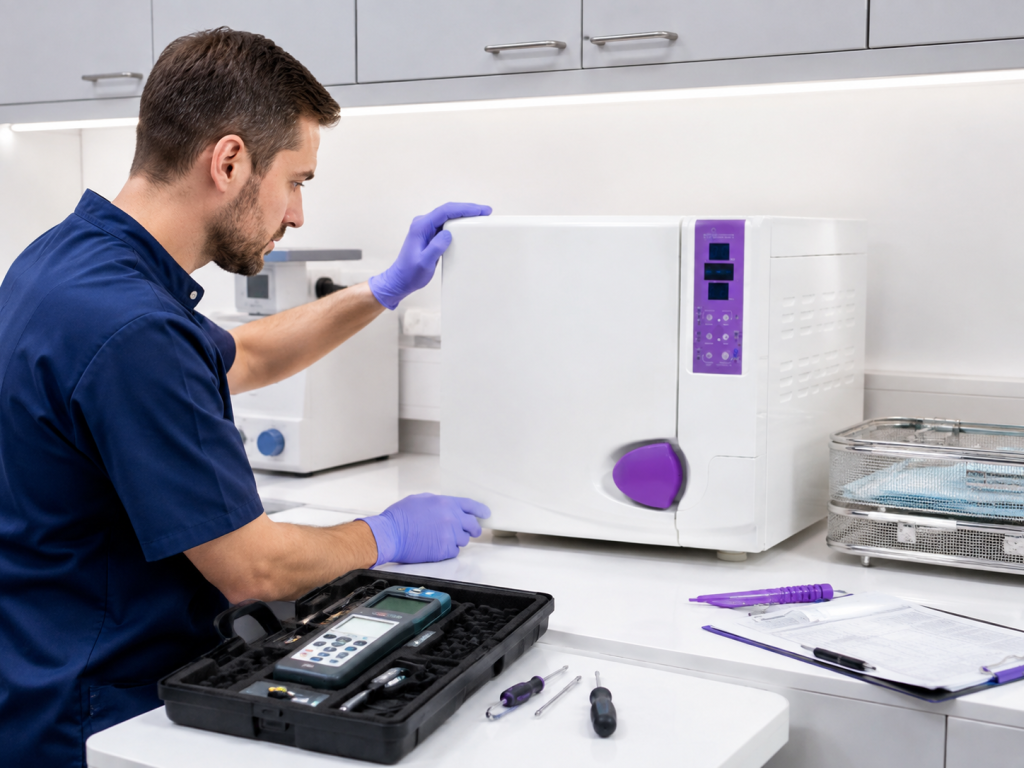
What Is the Difference Between Autoclave Validation, Testing and Servicing?
Autoclaves are relied upon every day in dental clinics, podiatry practices, veterinary surgeries, beauty clinics and other healthcare environments. But owning an autoclave is not simply a case of switching it on and assuming that every cycle is working correctly.
Three terms are often used when discussing autoclave maintenance and compliance: validation, testing and servicing. Although they are closely connected, they are not the same thing.
Understanding the difference can help clinics maintain reliable sterilisation processes, identify problems early and keep suitable records for their equipment.
What Is Autoclave Testing?
Autoclave testing refers to the routine checks used to confirm that the steriliser is performing as expected.
These tests may be carried out by clinic staff as part of the normal decontamination routine.
For vacuum autoclaves, commonly used tests include:
- Helix tests
- Bowie Dick tests
- Cycle parameter checks
- Vacuum or air leakage tests where applicable
- Inspection of cycle records
The purpose of routine testing is to provide evidence that the autoclave is operating correctly on a day-to-day basis.
For example, a Helix test is designed to assess the effectiveness of air removal and steam penetration within a hollow load. Bowie Dick testing can also be used to assess steam penetration in vacuum sterilisers.
Excel Healthcare supplies Helix testing systems and Bowie Dick test packs to help clinics carry out routine checks.
What Is Autoclave Validation?
Validation is a broader process used to confirm that the autoclave is capable of achieving the required sterilisation conditions consistently.
Rather than checking a single routine cycle, validation looks at whether the machine is operating correctly against defined performance requirements.
This may include:
- Temperature checks
- Pressure checks
- Calibration
- Cycle performance assessment
- Examination of safety systems
- Confirmation that the machine reaches the required sterilisation parameters
Validation is normally carried out by a qualified engineer or competent person using calibrated equipment.
The objective is to provide documented evidence that the autoclave is functioning as intended.
What Is Autoclave Servicing?
Servicing focuses on the physical condition and ongoing reliability of the autoclave.
During a service, an engineer may inspect, clean, adjust or replace components to help keep the machine operating correctly.
A typical autoclave service may include:
- Inspection of door seals
- Checking filters
- Examination of valves and pipework
- Cleaning internal components
- Calibration
- Function testing
- Replacement of service-kit parts
- Safety checks
- Examination of the pressure vessel
Servicing is preventative maintenance. Its purpose is to identify worn or failing components before they cause a breakdown or affect sterilisation performance.
Excel Healthcare’s autoclave service plans include annual servicing, a service kit, calibration and function testing, with higher-level plans also providing additional callout and parts cover.
Testing, Validation and Servicing at a Glance
Although the three processes overlap, their purposes are different.
Testing asks: Is the autoclave performing correctly during routine use?
Validation asks: Can the autoclave consistently achieve the required sterilisation conditions?
Servicing asks: Is the machine mechanically sound, maintained correctly and operating reliably?
All three contribute to a dependable sterilisation programme.
Why Routine Testing Does Not Replace Servicing
A machine may pass its daily or weekly tests while still developing mechanical wear.
Door seals, filters, valves, heating systems and sensors can deteriorate gradually over time. Routine testing may indicate that the machine is currently achieving its required cycle conditions, but it does not examine the physical condition of every component.
This is why planned servicing is still necessary even when an autoclave appears to be working normally.
Why Servicing Does Not Replace Routine Testing
The opposite is also true.
Having an autoclave professionally serviced does not remove the need for routine testing between service visits.
Conditions can change during everyday use because of:
- Heavy workloads
- Incorrect loading
- Water-quality issues
- Component wear
- Operator error
- Unexpected faults
Routine testing helps clinics identify these issues between scheduled service appointments.
Why Calibration Matters
Calibration checks whether the autoclave’s sensors and controls are measuring temperature, pressure and other cycle parameters accurately.
If a temperature sensor is inaccurate, for example, the displayed reading may not reflect the actual temperature inside the chamber.
Calibration is therefore an important part of validation and servicing.
Accurate measurements provide confidence that recorded cycle data reflects what actually happened inside the steriliser.
What Is a Written Scheme of Examination?
Autoclaves contain pressure vessels and may require examination under an appropriate written scheme of examination.
This is separate from everyday sterilisation testing and forms part of the safe management of pressure equipment.
Excel Healthcare provides autoclave inspections to support pressure-vessel examination and ongoing equipment compliance.
Keeping these documents organised helps clinics demonstrate that equipment has been maintained and examined appropriately.
What Records Should Clinics Keep?
Good record keeping is an important part of autoclave management.
Records may include:
- Sterilisation cycle reports
- Helix or Bowie Dick test results
- Validation certificates
- Service reports
- Calibration certificates
- Pressure vessel inspection documentation
- Fault and repair records
Keeping these records together makes it easier to identify performance trends and provide evidence of maintenance when required.
What Happens If an Autoclave Fails a Test?
A failed routine test should not simply be ignored and repeated until a successful result appears.
The clinic should follow its procedures and the manufacturer’s instructions.
Depending on the test and the fault, this may involve:
- Checking the machine has been loaded and operated correctly.
- Repeating the test where appropriate.
- Recording the result.
- Removing the autoclave from use if required.
- Contacting a qualified engineer for advice.
If the problem cannot be resolved, Excel Healthcare provides autoclave repairs for faults, breakdowns and technical issues.
Instruments processed during an unsuccessful or questionable cycle should not automatically be treated as sterile.
How Often Should an Autoclave Be Serviced?
The correct service interval depends on the autoclave model, usage and manufacturer’s recommendations.
Many clinics arrange an annual professional service alongside routine testing throughout the year.
High-use autoclaves may require additional attention depending on operating conditions and manufacturer guidance.
A planned service schedule can help reduce unexpected downtime and make maintenance costs easier to manage.
Why the Three Processes Work Together
Reliable sterilisation depends on more than one check.
Routine testing provides ongoing evidence of performance.
Validation confirms that the autoclave can achieve the required sterilisation conditions.
Servicing maintains the mechanical and electrical systems that allow the machine to continue operating reliably.
Together, these processes provide a more complete picture of the condition and performance of the autoclave.
Conclusion
Autoclave testing, validation and servicing perform different but complementary roles.
Testing monitors routine performance, validation confirms that the steriliser can achieve the required conditions, and servicing maintains the equipment itself.
Clinics should not view any one of these activities as a replacement for the others. Following the manufacturer’s recommendations, keeping clear records and arranging professional support when required can help maintain reliable sterilisation and reduce the risk of unexpected equipment failure.
FAQs
Is autoclave validation the same as servicing?
No. Validation confirms that the autoclave can achieve required sterilisation conditions, while servicing focuses on maintaining and inspecting the machine itself. The two processes may be carried out together during an engineer visit.
Does a Helix test validate an autoclave?
A Helix test is a routine performance test used to assess steam penetration and air removal. It forms part of ongoing testing but does not replace full professional validation.
How often should an autoclave be tested?
Testing frequency depends on the autoclave type, manufacturer’s instructions and the procedures followed by the clinic. Routine tests may be carried out daily or at other specified intervals.
Does an autoclave need servicing if it passes all its tests?
Yes. Passing routine tests does not confirm the condition of every mechanical component. Preventative servicing should still be completed according to the manufacturer’s recommended schedule.
What does an autoclave service plan include?
Excel Healthcare’s current service plans include annual servicing, a service kit, calibration and function testing. Higher-level plans also include additional callouts and parts allowances.