
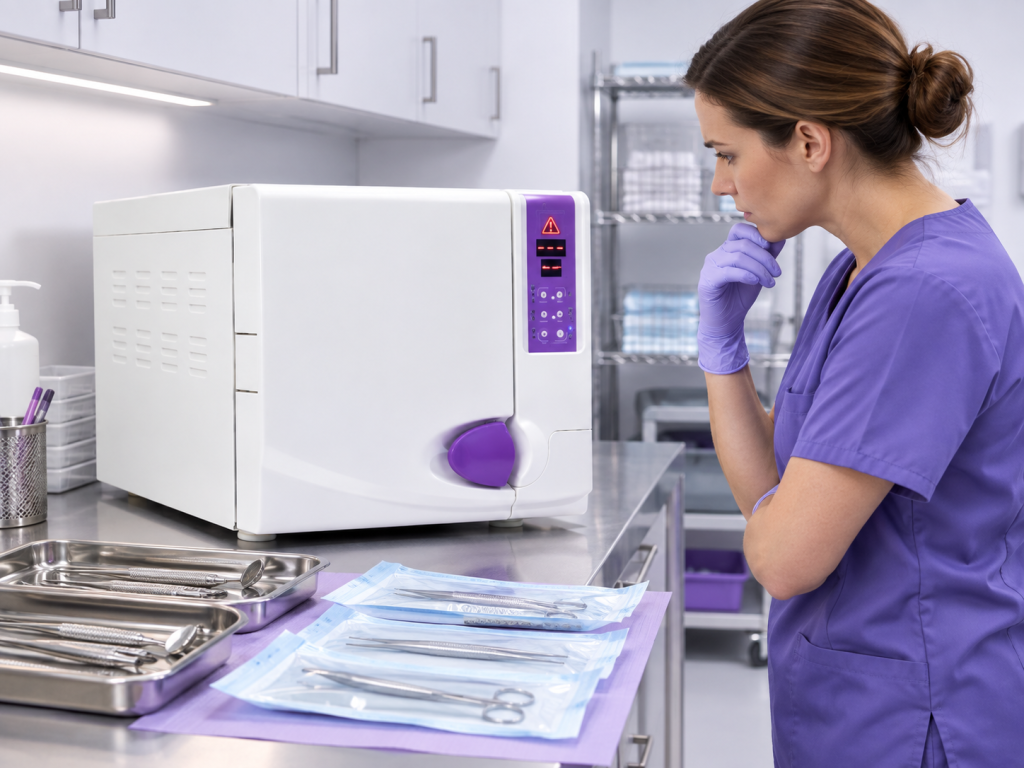
What Should a Clinic Do After a Failed Sterilisation Cycle?
A failed sterilisation cycle should never be ignored. If an autoclave does not complete its cycle correctly, or if test results suggest that the required sterilisation conditions were not achieved, the instruments processed in that load should not automatically be considered sterile.
The safest approach is to stop, record what happened, identify the cause and only return the equipment to normal use once the problem has been resolved.
For dental clinics, podiatry practices, veterinary surgeries, beauty clinics and other healthcare environments, having a clear response procedure can help reduce infection-control risks and avoid unnecessary disruption.
What Counts as a Failed Sterilisation Cycle?
A sterilisation cycle may be considered unsuccessful if:
- The autoclave displays an error code
- The required temperature or pressure is not reached
- The cycle stops before completion
- A Helix or Bowie Dick test fails
- Pouches remain wet after the cycle
- There is evidence of poor steam penetration
- The door does not seal correctly
- The autoclave records abnormal cycle data
- Instruments have been loaded incorrectly
A machine completing a cycle does not necessarily mean the load has been sterilised successfully. The cycle parameters and test results must also be satisfactory.
Do Not Use the Instruments
The first step after a failed sterilisation cycle is to treat the affected instruments as non-sterile.
They should not be:
- Used on patients
- Moved into sterile storage
- Mixed with successfully processed instruments
- Repackaged without being reprocessed correctly
The instruments should remain clearly identified until the cause of the failure has been investigated.
Check the Cycle Record
Review the autoclave cycle data carefully.
Look for:
- Maximum temperature reached
- Pressure achieved
- Cycle duration
- Error messages
- Aborted stages
- Drying performance
- Operator notes
Cycle records can often provide the first clue as to what went wrong.
If the machine has a printer or digital recording system, keep the failed cycle report with your maintenance and sterilisation records.
Check for Simple Operator Issues
Some failed cycles are caused by loading or operating errors rather than equipment faults.
Check whether:
- The chamber was overloaded
- Instruments were packed too tightly
- Sterilisation pouches were positioned correctly
- The correct cycle was selected
- The door was fully closed
- The water level was sufficient
- The reservoir contained the correct type of water
If the problem is clearly identified and corrected, a repeat cycle may be appropriate, provided this is consistent with the manufacturer’s instructions and your clinic procedures.
Review Routine Test Results
If a Helix or Bowie Dick test has failed, do not simply repeat it until you get a passing result.
A failed test may indicate a problem with:
- Air removal
- Steam penetration
- Vacuum performance
- Chamber conditions
- Door sealing
- Cycle control
Excel Healthcare supplies Helix testing systems and Bowie Dick test packs to support routine autoclave testing.
If test failures continue, professional inspection may be required.
Reprocess the Instruments Correctly
Once the cause has been resolved, the affected instruments should be reprocessed from the appropriate stage.
Depending on your clinic procedures, this may involve:
- Returning instruments to the cleaning stage
- Inspecting and drying them
- Repackaging in new sterilisation pouches where required
- Running a complete sterilisation cycle
- Confirming that the cycle parameters and test results are satisfactory
Do not assume that simply running the same failed load again is always enough.
When Should the Autoclave Be Taken Out of Use?
An autoclave should be taken out of service if there is evidence that it cannot achieve reliable sterilisation.
Examples include:
- Repeated failed cycles
- Repeated test failures
- Pressure problems
- Temperature inconsistencies
- Water leaks
- Door-seal failures
- Unusual noises
- Persistent error codes
If the cause is unclear, stop using the machine and arrange professional support.
Excel Healthcare provides autoclave repair services for supported models.
Record the Failure
Every failed sterilisation cycle should be documented.
Records may include:
- Date and time
- Autoclave identification
- Cycle number
- Error code
- Test result
- Load contents
- Operator
- Action taken
- Engineer report if applicable
Good record keeping makes it easier to identify recurring problems and provides useful evidence during servicing, validation or inspection.
Could the Problem Be Caused by the Load?
Yes. Not every failed cycle means the autoclave itself is faulty.
Problems can be caused by:
- Overloading
- Incorrect pouch placement
- Unsuitable instruments
- Poor pre-cleaning
- Incorrect packaging
- Using the wrong programme
If failures happen only with certain load types, review how those instruments are being prepared and positioned.
Could Water Quality Be the Cause?
Poor water quality can contribute to scale, sensor problems and reduced autoclave performance.
Only use the type of water recommended by the manufacturer.
Mineral build-up can affect:
- Heating
- Valves
- Sensors
- Steam generation
- Internal pipework
If scale or contamination is visible, the autoclave may need professional cleaning or servicing.
When Is Professional Servicing Needed?
If a failed cycle cannot be explained by a simple loading or operating issue, professional servicing may be required.
An engineer can inspect:
- Door seals
- Heating systems
- Temperature sensors
- Pressure sensors
- Valves
- Vacuum pumps
- Internal pipework
- Control systems
Excel Healthcare offers autoclave service plans that include annual servicing, calibration and function testing, with higher-level plans providing additional callout and parts cover.
How Can Clinics Reduce the Risk of Failed Cycles?
Good maintenance and consistent operating procedures can reduce the likelihood of sterilisation failures.
Useful steps include:
- Following manufacturer loading instructions
- Avoiding overloading
- Using suitable sterilisation pouches
- Cleaning instruments properly before autoclaving
- Carrying out routine tests
- Keeping cycle records
- Using the correct water
- Arranging regular servicing
- Training staff consistently
Preventative maintenance is particularly important in busy clinics where the autoclave is used several times each day.
Why Failed Cycles Matter
A failed sterilisation cycle is more than an inconvenience.
It can lead to:
- Delays in treatment
- Instrument shortages
- Reprocessing time
- Additional consumable costs
- Equipment downtime
- Infection-control risks
The quicker the cause is identified and corrected, the easier it is to minimise disruption.
Conclusion
After a failed sterilisation cycle, the affected instruments should be treated as non-sterile until they have been correctly reprocessed.
Clinics should review the cycle record, check for loading or operating errors, record the failure and repeat the sterilisation process only when it is safe to do so.
Repeated failures, abnormal cycle data or unsuccessful routine tests should be investigated by a qualified engineer.
A clear failure procedure, supported by regular testing, servicing and staff training, helps clinics maintain reliable sterilisation and reduce unexpected downtime.
FAQs
Can instruments be used after a failed autoclave cycle?
No. Instruments from a failed or questionable cycle should not be treated as sterile.
Can I simply run the failed load again?
Only after identifying and correcting the cause of the failure. Depending on clinic procedures, instruments may need to be cleaned, inspected and repackaged before reprocessing.
What should I do if a Helix test fails?
Record the result, check the machine and load setup, and follow the manufacturer’s instructions. Repeated failures should be investigated professionally.
Does one failed cycle mean the autoclave is broken?
Not necessarily. A failed cycle can be caused by overloading, incorrect settings or poor loading. Repeated failures are more likely to indicate a technical problem.
When should I call an autoclave engineer?
Call an engineer if the fault repeats, the machine cannot reach the required temperature or pressure, test results remain unsuccessful or there are leaks, unusual noises or persistent error codes.