
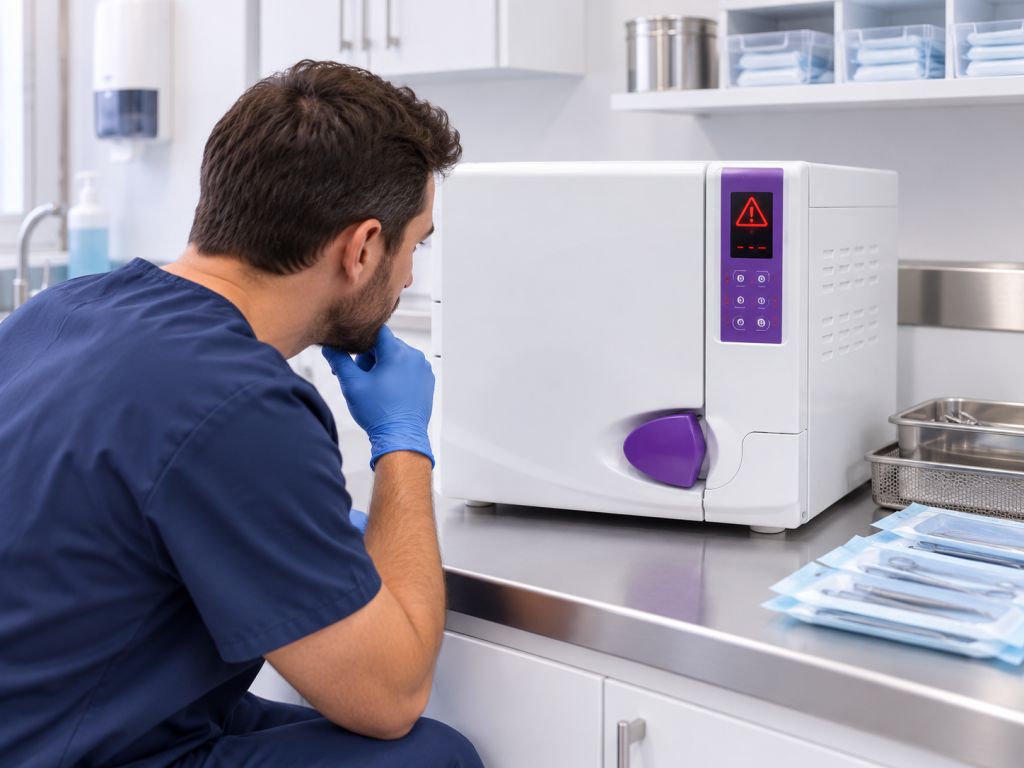
When Does an Autoclave Fault Need an Emergency Engineer?
Autoclave faults can range from minor operating issues to problems that require urgent professional attention. For clinics that depend on sterilised instruments throughout the day, knowing when to stop using the machine and arrange an engineer can help reduce downtime and avoid further damage.
Not every error message requires an emergency callout. Some issues may be caused by loading, water levels or an incorrectly closed door. However, repeated failures, leaks, pressure problems or electrical faults should never be ignored.
Excel Healthcare offers an autoclave emergency callout service for supported Eclipse, Elite, Enigma and New Generation models, with attendance within 24 hours on weekdays.
When Should You Stop Using an Autoclave Immediately?
You should stop using the autoclave and seek professional advice if there is any indication that the machine may be unsafe or unable to complete a reliable sterilisation cycle.
Examples include:
- Repeated cycle failures
- Significant water or steam leaks
- Burning smells or signs of overheating
- Electrical faults
- Failure to reach the required temperature or pressure
- Door locking or sealing problems
- Persistent error codes
- Unusual mechanical noises
- Failed routine test results that cannot be explained
If the sterilisation process cannot be confirmed as successful, instruments from the affected cycle should not be treated as sterile.
Repeated Cycle Failures
A single failed cycle may sometimes be caused by an operating issue such as overloading, incorrect pouch placement or selecting the wrong programme.
Repeated failures are more concerning.
If several cycles fail despite correct loading and operation, there may be a fault with:
- Heating systems
- Temperature sensors
- Pressure sensors
- Vacuum pumps
- Valves
- Door seals
- Internal pipework
- Electronic controls
Continuing to repeatedly restart a faulty machine can increase downtime and potentially cause further damage.
Excel Healthcare provides autoclave repair support for Enigma, Eclipse and New Generation models.
Water or Steam Leaking from the Autoclave
Minor condensation around some parts of the machine may be normal depending on the model, but unexplained water or steam leakage should be investigated.
Possible causes include:
- Damaged door seals
- Loose connections
- Blocked drainage
- Valve faults
- Internal pipework leaks
- Pressure-related problems
A significant steam leak presents a potential burn risk and should not be ignored.
If water is appearing beneath the machine or steam is escaping from around the door during operation, stop the cycle where safe to do so and seek technical advice.
The Autoclave Will Not Reach Pressure or Temperature
Steam sterilisation depends on the autoclave reaching and maintaining defined cycle conditions.
If the machine repeatedly struggles to reach the required temperature or pressure, the cause may involve:
- Heating-element failure
- Steam-generation problems
- Door seal leaks
- Sensor faults
- Valve problems
- Scale accumulation
A cycle that has not achieved its required parameters should not be assumed to have sterilised the load.
The Door Will Not Lock or Seal
The autoclave door forms part of the pressure system and must operate correctly.
Warning signs include:
- Difficulty closing the door
- Failure to lock
- Steam escaping around the seal
- Water leaking around the door
- The cycle refusing to start
- Pressure failing to build
Do not force the door closed or attempt to modify the locking mechanism.
A worn gasket may be straightforward to replace, but problems with the locking system or pressure integrity should be examined professionally.
Electrical or Burning Smells
Any burning smell, smoke, sparking or electrical fault requires immediate attention.
Switch off and isolate the autoclave if it is safe to do so and do not continue using it until it has been professionally inspected.
These symptoms can indicate a problem with:
- Wiring
- Heating components
- Control boards
- Pumps
- Electrical connections
This is one of the clearest situations where urgent engineer assistance is appropriate.
Persistent Error Codes
Modern autoclaves use error codes to identify problems during operation.
An occasional code may result from a simple issue such as low water or an incorrectly closed door. However, the same error appearing repeatedly suggests that the underlying problem has not been resolved.
Record:
- The error code
- When it occurred
- Which programme was running
- The stage at which the cycle stopped
- Whether the fault repeats
This information can help the engineer diagnose the issue more quickly.
Unusual Noises
Autoclaves normally produce sounds as pumps, valves and heating components operate.
New sounds such as grinding, squealing, repeated clicking or excessive vibration may indicate mechanical wear or component failure.
If the noise is accompanied by a failed cycle, leak, error code or loss of performance, stop using the machine and arrange an inspection.
Failed Sterilisation Tests
Routine autoclave tests can help identify problems before a complete breakdown occurs.
Repeated failures of tests such as Helix or Bowie Dick tests may indicate problems with:
- Air removal
- Steam penetration
- Vacuum performance
- Door sealing
- Cycle control
Excel Healthcare supplies Helix testing systems and Bowie Dick test packs for routine performance checking.
If a test repeatedly fails after correct setup, professional investigation may be required.
When Is an Emergency Callout Better Than a Routine Repair?
A routine repair may be suitable when:
- The machine is not urgently required
- Another autoclave is available
- The fault is intermittent but manageable
- The clinic can continue operating safely
An emergency callout may be more appropriate when:
- The clinic has no working autoclave
- Patient appointments are likely to be affected
- Instrument processing has stopped
- The machine has a serious leak or electrical fault
- The autoclave repeatedly fails cycles
- The issue cannot be resolved through normal operator checks
Excel Healthcare’s emergency autoclave callout is designed for situations where faster attendance is required, with a weekday service offering attendance within 24 hours.
What Should You Check Before Calling an Engineer?
Before booking a callout, it can be useful to rule out straightforward operating issues.
Check:
- The water level
- The type of water being used
- Whether the door is fully closed
- Whether the chamber is overloaded
- Whether drainage valves are positioned correctly
- Whether the correct programme has been selected
- Whether the fault disappears after following the manufacturer’s reset procedure
Do not dismantle the autoclave or attempt internal repairs unless you are qualified to do so.
Having the model, serial number and fault details available will also help when arranging an engineer.
Why Preventative Servicing Still Matters
Emergency repairs deal with faults that have already occurred. Regular servicing is intended to reduce the chance of those faults developing in the first place.
Planned maintenance can identify:
- Worn seals
- Failing valves
- Calibration issues
- Scale accumulation
- Sensor problems
- Components approaching the end of their service life
Excel Healthcare’s autoclave service plans include annual servicing, service kits, calibration and function testing, with Gold and Platinum plans including additional callouts.
What Information Should You Give the Engineer?
Providing clear information can help speed up diagnosis.
Have the following available:
- Autoclave make and model
- Serial number
- Error code
- Description of the fault
- When the problem started
- Whether it happens every cycle
- Any recent service or repair history
- Results from recent routine tests
Excel Healthcare’s emergency callout booking process asks for the model, fault and serial number so the service team has key information before attendance.
Conclusion
An autoclave fault needs urgent engineer attention when the machine cannot reliably complete sterilisation cycles, develops significant leaks, suffers an electrical problem or repeatedly displays faults that cannot be resolved through normal operator checks.
Clinics should never continue using an autoclave simply because they need instruments processed quickly. If sterilisation performance is uncertain, the machine should be taken out of use until the issue has been investigated.
For supported models requiring urgent assistance, Excel Healthcare provides an autoclave emergency callout service with weekday attendance within 24 hours.
FAQs
What counts as an autoclave emergency?
A fault is more likely to require urgent attention when the clinic has lost sterilisation capacity, the machine repeatedly fails cycles, or there is evidence of a significant leak, pressure problem or electrical fault.
Can I keep using an autoclave after an error code?
It depends on the cause. Follow the manufacturer’s instructions, but repeated errors or failed cycles should be professionally investigated.
Should I call an engineer if the autoclave is leaking?
A significant or unexplained water or steam leak should be investigated, particularly if it affects pressure or cycle completion.
How quickly can Excel Healthcare attend an emergency autoclave fault?
Excel Healthcare currently advertises emergency autoclave callouts with attendance within 24 hours on weekdays for supported models.
Which autoclaves does Excel Healthcare provide emergency callouts for?
The emergency callout page lists Eclipse, Elite, Enigma and New Generation models.