
Do You Still Need an Autoclave If You Use an Ultrasonic Cleaner?
Ultrasonic cleaners are widely used in clinics, salons, and studios to remove debris from reusable tools. But a common question is whether an ultrasonic cleaner alone is enough, or if an autoclave is still required.
The short answer is simple: an ultrasonic cleaner does not replace an autoclave. Instead, the two work together as part of a complete sterilisation process.
This guide explains the difference, why both are important, and how to use them correctly.
What Does an Ultrasonic Cleaner Actually Do?
An ultrasonic cleaner uses high-frequency sound waves to create tiny bubbles in a cleaning solution. These bubbles collapse rapidly in a process called cavitation, which removes dirt, debris, and biological material from instruments.
Ultrasonic cleaners are highly effective for:
- Removing visible contamination
- Cleaning hard-to-reach areas
- Preparing instruments before sterilisation
However, they do not kill all bacteria, viruses, or spores.
What Does an Autoclave Do?
An autoclave uses pressurised steam at high temperatures to sterilise instruments. This process destroys microorganisms, including bacteria, viruses, and spores, making instruments safe for reuse.
Unlike ultrasonic cleaners, autoclaves provide:
- Full sterilisation
- Compliance with infection control standards
- Safe reuse of instruments in clinical environments
For most professional settings, a Class B autoclave is considered the gold standard.
Why You Need Both
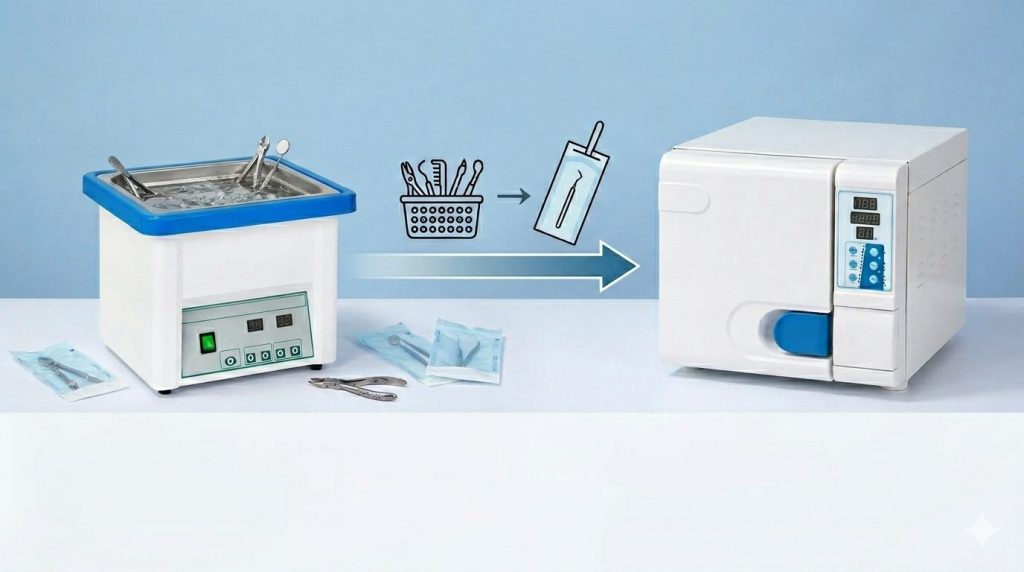
Ultrasonic cleaners and autoclaves serve different purposes and are designed to work together.
A typical workflow looks like this:
- Instruments are placed in an ultrasonic cleaner to remove debris
- Tools are rinsed and dried
- Instruments are placed into sterilisation pouches
- Tools are sterilised in an autoclave
Without the ultrasonic cleaning stage, debris can remain on instruments, reducing the effectiveness of sterilisation. Without the autoclave, instruments are not fully sterilised.
Can You Use an Ultrasonic Cleaner on Its Own?
In most professional environments, the answer is no.
Using an ultrasonic cleaner alone may be acceptable for:
- Non-critical tools
- Items that do not come into contact with skin
- Pre-cleaning before further processing
However, for any tools that:
- Touch skin
- May break the skin
- Are reused between clients or patients
…sterilisation in an autoclave is strongly recommended.
Where This Matters Most
Using both ultrasonic cleaners and autoclaves is particularly important in:
- Dental clinics
- Podiatry and chiropody practices
- Tattoo and piercing studios
- Beauty and aesthetics salons
- Veterinary Clinics
In these environments, proper cleaning and sterilisation are essential for both safety and compliance.
Choosing the Right Equipment
If you are setting up or upgrading your sterilisation process, it’s important to choose equipment that works together.
A reliable ultrasonic cleaner can be used alongside a Class B autoclave to create a complete system. You can view suitable options on Excel Healthcare’s ultrasonic cleaners page, along with their range of autoclaves designed for professional use.
Common Mistakes to Avoid
Some of the most common issues seen in clinics and salons include:
- Assuming ultrasonic cleaning is enough on its own
- Skipping the cleaning stage before autoclaving
- Overloading the ultrasonic cleaner
- Using the wrong cleaning solution
Avoiding these mistakes helps ensure that instruments are both clean and fully sterilised.
Frequently Asked Questions
Does an ultrasonic cleaner sterilise instruments?
No. Ultrasonic cleaners remove debris but do not sterilise instruments.
Can I skip the ultrasonic cleaner and just use an autoclave?
It is not recommended. Cleaning removes debris that could affect sterilisation.
Do beauty salons need both an ultrasonic cleaner and an autoclave?
In many cases, yes. Especially where reusable tools are used on clients.
What happens if instruments are not cleaned before sterilisation?
Debris can prevent effective sterilisation, increasing the risk of contamination.
Final Thoughts
An ultrasonic cleaner is an important first step in the cleaning process, but it does not replace sterilisation. For safe and compliant instrument reuse, both cleaning and sterilisation are required.
Using an ultrasonic cleaner alongside an autoclave ensures that instruments are properly prepared and fully sterilised, helping clinics and studios maintain high standards of hygiene and safety.