
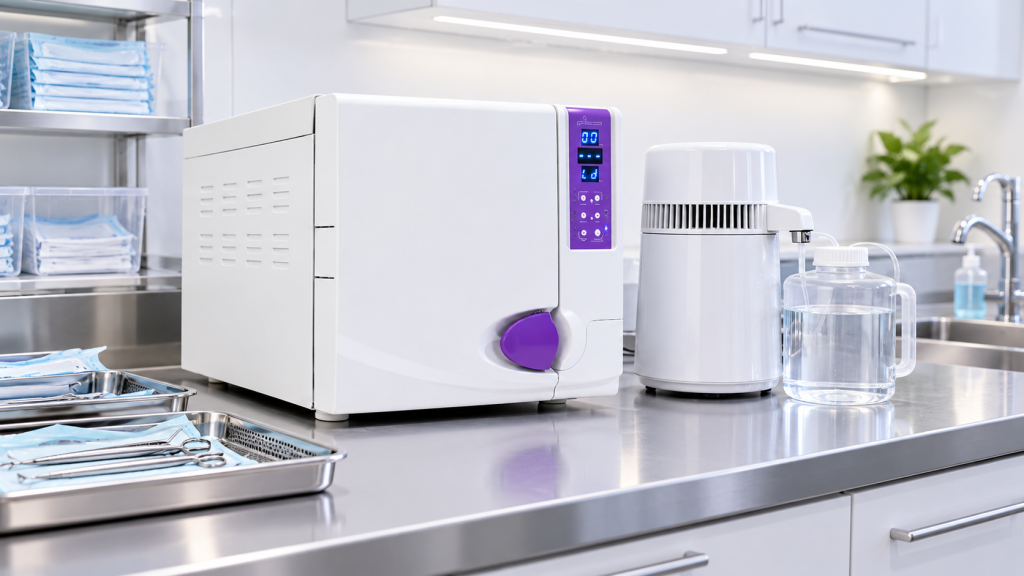
What Water Should You Use in an Autoclave?
The water used in an autoclave can have a significant effect on its performance, reliability and lifespan. Although it may be tempting to simply fill an autoclave with ordinary tap water, the minerals and other contaminants it contains can build up inside the steriliser and potentially damage important components.
The correct water depends on the autoclave manufacturer’s instructions. For Excel Healthcare autoclaves, distilled water should be used.
Using the right water helps reduce scale and deposits, protects internal components and supports consistent steam generation during sterilisation.
Why Does Water Quality Matter in an Autoclave?
Autoclaves create steam by heating water. Anything contained within that water can therefore potentially pass through the steam-generation system and leave deposits behind.
Ordinary tap water can contain minerals such as calcium and magnesium. Over time, these can contribute to scale developing on:
- Heating components
- Steam generators
- Valves
- Sensors
- Internal pipework
- Water reservoirs
This can reduce efficiency and may eventually contribute to faults or breakdowns.
Using suitable high-purity water helps minimise these risks.
What Water Does Excel Healthcare Recommend?
Excel Healthcare specifies distilled water for use with its autoclaves.
Distilled water has been purified through a process in which water is boiled into steam and then condensed back into liquid. Many impurities and dissolved minerals are left behind during this process.
This produces water with very low mineral content, making it much better suited to steam sterilisation equipment than ordinary tap water.
Excel Healthcare supplies distilled water for autoclaves as well as a wider range of water treatment devices for practices that regularly need high-quality water.
Can You Use Tap Water in an Autoclave?
You should not use tap water in an Excel Healthcare autoclave.
Tap water quality varies considerably depending on location. Even water that appears perfectly clear can contain dissolved minerals that are invisible to the eye.
When the water is repeatedly heated to produce steam, those minerals can remain behind and gradually form deposits.
Hard-water areas can be particularly problematic because of their higher mineral content.
Potential consequences of using unsuitable water include:
- Scale accumulation
- Blocked valves
- Reduced heating efficiency
- Sensor problems
- Steam-generator damage
- Increased maintenance requirements
- Shorter equipment lifespan
Always follow the manufacturer’s water specification rather than assuming that drinking-quality water is suitable for sterilisation equipment.
What Is Distilled Water?
Distilled water is produced through evaporation and condensation.
Water is heated until it becomes steam. The steam is then collected and condensed into a separate container, leaving many dissolved minerals and impurities behind.
The resulting purified water is useful in applications where mineral deposits could interfere with equipment performance.
This is why distilled water is commonly associated with steam sterilisers and other sensitive equipment.
What Is Demineralised Water?
Demineralised water has had dissolved mineral ions removed, usually using processes such as ion exchange or membrane filtration.
It is also sometimes referred to as deionised water, although the exact treatment processes and resulting purity can differ.
Distilled and demineralised water are therefore not necessarily identical.
For this reason, you should not substitute one for another simply because they both appear to be purified water. Always use the type specified by the autoclave manufacturer.
For Excel Healthcare autoclaves, that specification is distilled water.
What About Reverse Osmosis Water?
Reverse osmosis uses a membrane to remove a large proportion of minerals and contaminants from mains water.
It can be a convenient way of producing purified water in larger quantities, particularly for busy clinics.
Excel Healthcare supplies the Osmo Plus system as part of its water-treatment range.
However, the suitability of any treated water for a particular autoclave must still be confirmed against the equipment manufacturer’s specifications.
Should You Buy Distilled Water or Produce Your Own?
This often depends on how much water the clinic uses.
A smaller practice running relatively few autoclave cycles may find bottled distilled water convenient.
A busier clinic may benefit from producing purified water onsite using suitable water-treatment equipment.
Factors to consider include:
- Number of autoclaves
- Number of cycles per day
- Water consumption
- Storage space
- Cost of bottled water
- Convenience
- Availability of mains water
Excel Healthcare’s water treatment devices include options for practices with different water requirements.
Why Clinics Use Water Distillers
A water distiller allows a clinic to produce distilled water onsite rather than continually purchasing bottled supplies.
For practices running several sterilisation cycles each day, this can provide a convenient source of suitable water.
Excel Healthcare supplies the Tower Puro 200 Water Distiller as part of its water-treatment range.
A distiller also needs routine cleaning because the minerals removed from the water remain inside the boiling chamber.
Regular cleaning helps maintain the efficiency of the unit and prevents mineral deposits from building up.
Can Poor Water Quality Damage an Autoclave?
Yes. Persistent use of unsuitable water can contribute to internal deposits and component problems.
Potential areas affected include:
- Steam generators
- Heating elements
- Water-level sensors
- Pumps
- Solenoid valves
- Pipework
- Chambers and reservoirs
Scale can also make servicing more difficult and may contribute to repeated operational problems.
If an autoclave is developing unexplained faults or visible mineral deposits, water quality should be considered alongside other possible causes.
Excel Healthcare provides autoclave service plans that include annual servicing, calibration and function testing.
How Often Should Autoclave Water Be Changed?
Follow the cleaning and water-management instructions supplied with the autoclave.
Fresh distilled water should be used as required, while waste-water tanks and reservoirs should be emptied and cleaned at the intervals specified by the manufacturer.
Leaving contaminated or dirty water inside the system can contribute to:
- Deposits
- Odours
- Biofilm development
- Blockages
- Poor equipment performance
Good water management is therefore part of routine autoclave maintenance rather than simply a matter of filling the reservoir when it becomes empty.
Does Using Distilled Water Remove the Need for Servicing?
No.
Correct water helps protect the autoclave, but it does not replace routine maintenance.
An autoclave still contains components that wear with use, including seals, valves, pumps and sensors.
Regular servicing, testing and validation remain important even when the correct water is being used.
What Water Should You Use in an Excel Healthcare Autoclave?
The answer is straightforward.
Use distilled water.
Excel Healthcare specifies distilled water for its autoclave range to help prevent internal blockages and protect components.
If you regularly operate an autoclave, producing or purchasing suitable water should therefore form part of your normal sterilisation-room routine.
You can explore Excel Healthcare’s complete range of water treatment devices, including water-treatment systems, cartridges and distilled-water solutions for clinical environments.
Conclusion
The quality of water used in an autoclave can affect everything from steam generation to the lifespan of internal components.
Tap water may contain minerals that create scale and deposits, while different forms of purified water are not automatically interchangeable.
The safest approach is always to follow the autoclave manufacturer’s instructions.
For Excel Healthcare autoclaves, distilled water should be used. Combining the correct water with regular cleaning, testing and servicing can help maintain reliable sterilisation performance and reduce avoidable equipment problems.
FAQs
Can I use tap water in an autoclave?
Not unless the autoclave manufacturer specifically permits it. Excel Healthcare requires distilled water for its autoclaves.
Is distilled water the same as demineralised water?
No. They are produced using different purification processes and may have different specifications.
Can I use demineralised water instead of distilled water?
Only if the autoclave manufacturer confirms that it is suitable. Excel Healthcare specifies distilled water for its autoclaves.
Why does tap water damage autoclaves?
Tap water can contain dissolved minerals that remain behind when water is heated. These deposits can build up inside valves, heating systems, sensors and pipework.
Can a clinic make its own distilled water?
Yes. A suitable water distiller can allow a clinic to produce distilled water onsite rather than relying entirely on bottled supplies.
Where can I buy water treatment equipment for an autoclave?
Excel Healthcare supplies water treatment devices including water-treatment systems, cartridges and distilled water for clinical sterilisation equipment.