
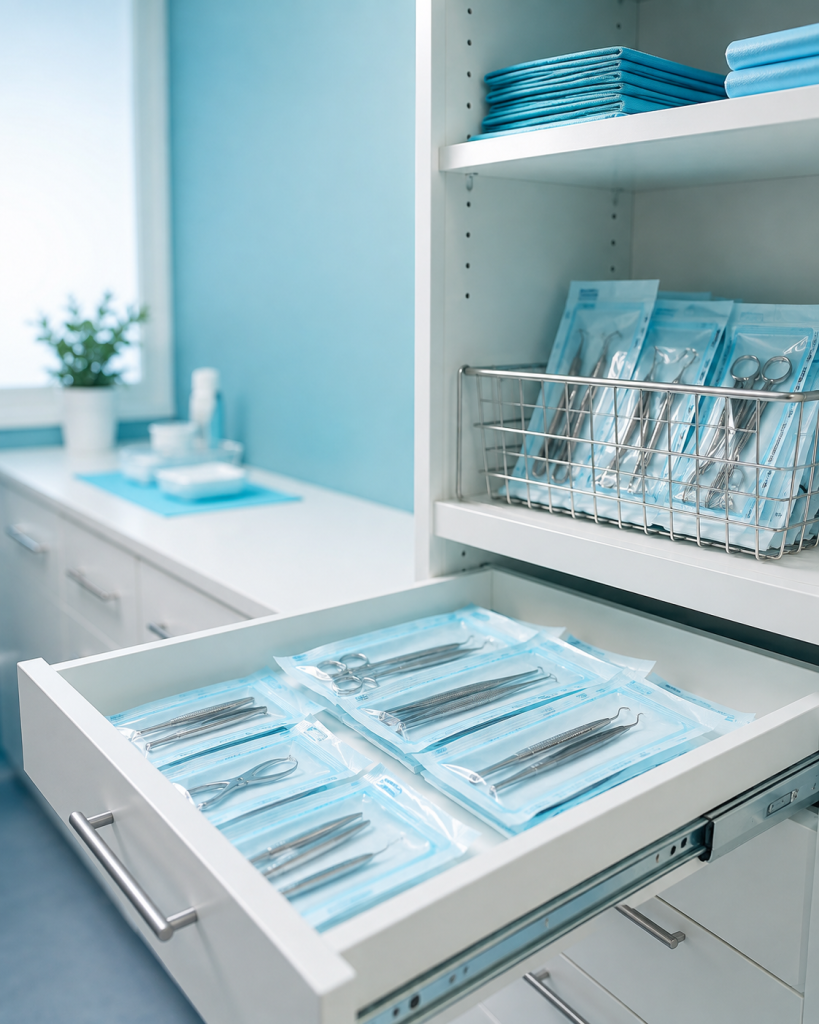
How Should Sterilised Instruments Be Stored After Autoclaving?
Sterilisation is only one part of the instrument decontamination process. Once instruments have completed a successful autoclave cycle, they still need to be handled and stored correctly to help protect them from contamination before they are used.
Poor storage can compromise the sterile barrier, particularly if pouches become wet, damaged or incorrectly handled. For clinics and healthcare environments, having a clear process for storage after sterilisation is therefore an important part of maintaining good infection prevention standards.
In this guide, we look at how sterilised instruments should be stored after autoclaving, what to check before putting them away and when instruments may need to be reprocessed.
Why correct storage matters after sterilisation
An autoclave uses pressurised steam at high temperatures to sterilise suitable instruments. However, once the cycle has finished, those instruments still need protection from their surrounding environment.
Wrapped instruments rely on the integrity of their sterilisation pouch or other approved packaging to maintain the barrier between the sterile instrument and potential contamination.
If that packaging becomes torn, punctured, wet or opened, the instrument should no longer automatically be regarded as suitable for use simply because it previously completed a sterilisation cycle.
Correct storage helps to:
- reduce the risk of instruments becoming contaminated
- protect sterilisation pouches from damage
- support effective stock rotation
- improve traceability
- keep clean and contaminated instruments clearly separated
- maintain an organised decontamination process
This means the journey from cleaning and sterilisation through to storage and eventual use needs to be considered as one complete process.
Make sure instruments are dry
Moisture is one of the most important things to look for following an autoclave cycle.
Sterilised instruments and their packaging should be dry before they are transferred into storage. A wet pouch can compromise the sterile barrier and may allow contamination to pass through the packaging.
If pouches repeatedly come out of the autoclave wet, it should not simply be treated as a normal part of the process. Possible causes may include incorrect loading, overloading, unsuitable packaging, drying-cycle issues or equipment performance problems.
Persistent wet loads should be investigated rather than simply allowing the pouches to dry and putting them into storage.
Check every sterilisation pouch before storage
Before storing wrapped instruments, take a moment to inspect the packaging.
Check that:
- the pouch is completely sealed
- there are no tears or punctures
- the packaging is dry
- the pouch has not been crushed or damaged
- the instrument has not pierced the packaging
- any required process indicators have responded appropriately
A pouch may appear intact at first glance while still having a damaged seal or small puncture.
Handling pouches carefully after sterilisation can help prevent this type of damage.
Store instruments in a clean, dry area
Sterilised instruments should be kept in a designated clean storage area that protects them from contamination.
Avoid storing sterile packs next to sinks, cleaning chemicals or areas where contaminated instruments are handled. Open worktops in busy treatment areas are also generally unsuitable for long-term storage because the instruments may be exposed to splashes, dust and frequent handling.
Enclosed cupboards or drawers can provide additional protection, provided they are themselves kept clean, dry and appropriately maintained.
Storage areas should ideally be:
- clean and well organised
- dry
- protected from dust and splashes
- away from contaminated instrument processing areas
- free from unnecessary handling
- suitable for effective stock rotation
Care should also be taken not to cram too many pouches into a drawer or cupboard. Excessive pressure can crease, tear or puncture the packaging.
Handle sterilised instruments as little as possible
Every time a sterile pack is moved or handled, there is another opportunity for it to become damaged.
Once instruments have been sterilised, checked and stored, unnecessary handling should therefore be kept to a minimum.
When removing instruments for use, staff should also avoid touching neighbouring packs unnecessarily.
Good organisation can help. For example, grouping instruments logically and maintaining sensible stock levels can reduce the amount of searching and rearranging needed during the working day.
Keep clean and contaminated instruments separate
One of the fundamental principles of effective decontamination is maintaining a clear progression from dirty instruments to clean and sterilised instruments.
Sterilised items should not be stored in areas where used instruments are received or cleaned.
Where possible, working practices and the layout of the decontamination area should create a clear flow from contaminated equipment towards clean, sterilised and stored equipment.
This reduces the likelihood of accidental cross-contamination and makes the process easier for staff to follow consistently.
How long can wrapped instruments be stored?
For dental practices in England, Health Technical Memorandum HTM 01-05 states that wrapped instruments may be stored for up to one year when the appropriate processes and storage arrangements are followed.
The guidance also makes an important distinction between steriliser types. Instruments may be wrapped before sterilisation when using suitable Type B or Type S cycles, while instruments processed in a Type N steriliser are wrapped after sterilisation.
However, a maximum storage period should never replace a visual check of the packaging.
Even if an instrument is well within the permitted storage period, it should not be used if the pouch has become damaged, opened, wet or otherwise compromised.
Clinics should also follow the manufacturer’s instructions for the sterilisation packaging they use, together with any relevant sector-specific guidance and their own documented infection prevention procedures.
What about unwrapped instruments?
Unwrapped instruments require particularly careful handling because there is no sterile barrier protecting them during storage.
HTM 01-05 states that unwrapped instruments kept in the clinical area should be stored dry and protected from contamination, such as within cupboards or covered drawer inserts, rather than on open work surfaces.
For dental practices, the guidance gives a maximum storage period of one day for unwrapped instruments kept within the clinical area.
This is one of the reasons why wrapped instrument storage can offer practical advantages when instruments need to remain protected for longer periods.
Different healthcare environments may have different policies, so organisations should always follow the guidance applicable to their particular sector.
Use clear labelling and stock rotation
Good storage is not only about protecting instruments physically. It should also make it easy to identify when instruments were processed and ensure older stock is used appropriately.
A simple first-in, first-out system can help prevent sterilised instruments from remaining at the back of a cupboard indefinitely.
Depending on the practice’s procedures, labelling and traceability information may include details such as:
- sterilisation date
- cycle or batch information
- contents of the pouch
- any required expiry or review date
Clear records also make it easier to trace instruments back to the relevant sterilisation cycle where required.
When should a stored instrument be reprocessed?
A previously sterilised instrument should not be assumed to remain suitable for use regardless of what happens to its packaging.
Reprocessing should be considered where:
- the pouch is torn or punctured
- the seal has failed
- the pouch has become wet
- the package has been opened
- the instrument has damaged the packaging
- there is uncertainty about how the instrument has been stored
- the applicable storage period has been exceeded
If there is doubt about the integrity of the sterile barrier, the safest approach is to follow the organisation’s infection prevention procedure and reprocess the instrument where appropriate.
Storage is part of the sterilisation process
Effective sterilisation does not finish when the autoclave door opens.
Cleaning, inspection, packaging, sterilisation, drying, storage and handling all contribute to the condition of an instrument at the point it is needed.
A well-managed storage system should therefore protect instruments from contamination, preserve packaging integrity and help staff identify and retrieve instruments without unnecessary handling.
For dental practices, HTM 01-05 also specifically advises that instruments should not be stored on open work surfaces and that wrapped instrument storage should be managed so the recommended storage period is not exceeded.
By treating storage as an essential part of the decontamination process rather than an afterthought, clinics can help maintain safer and more consistent instrument handling procedures.
Reliable sterilisation equipment from Excel Healthcare
Excel Healthcare supplies autoclaves, ultrasonic cleaners, sterilisation pouches and other products designed to support effective instrument decontamination across dental, medical, veterinary, podiatry, beauty and other professional environments.
Choosing appropriate equipment is only part of maintaining an effective process. Correct cleaning, sterilisation, handling and storage all work together to help protect instruments until they are required.
Explore our sterilisation equipment and healthcare consumables, or contact Excel Healthcare if you need help choosing suitable equipment for your practice.